Excavator: 7 types and their use on construction sites
When it comes to earthmoving, choosing the wrong equipment can mean not only higher costs but also several days of project delays. Not every excavator is suitable for every terrain or for every type of excavation. While one machine can handle moving around the city without the need for transportation, another can handle mud, slopes or deep excavations. In this article, we will look at the most common types of excavators, their uses and advise you on how to choose the right machine for your project.

Classification of excavators by chassis
The chassis is one of the most important elements of any excavator. It affects the stability of the machine, its mobility and its ability to work in various conditions. In practice, you will most often encounter two basic categories: wheeled and tracked excavators.
The choice between them should not be random. Each type has its own specifics and achieves the best results in different conditions.
Wheel excavators
Wheeled excavators for construction work are used mainly in cities and on projects where frequent movement between work sites is necessary. These machines reach speeds of around 30 to 40 km/h, so they can move on public roads under their own power and can travel on paved roads without the need to load onto a trailer or semi-trailer.
Their advantage is high mobility, speed of movement and easy maneuvering. Therefore, they are often used in road construction and repair, construction of engineering networks or municipal works.
Modern wheeled excavators achieve high performance even in demanding tasks. For example, machines weighing over 16 tons can work at a depth of almost 5 meters and their working range exceeds 8 meters. These parameters allow you to effectively carry out large excavation works and handling of bulk materials.
Wheel excavator 16 tons or more
Modern wheeled excavators achieve high performance even in demanding tasks. For example, machines weighing over 16 tons can work at a depth of almost 5 meters and their working range exceeds 8 meters.
Such parameters allow for efficient performance of extensive excavation work and handling of bulk materials.
Crawler excavators
Crawler excavators are designed primarily for demanding conditions. Their chassis distributes the weight of the machine over a larger area, reducing ground pressure and improving stability.
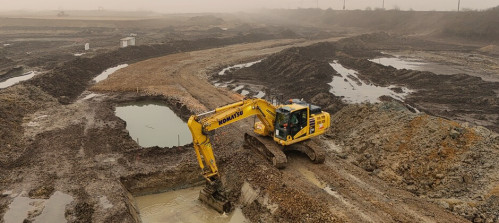
You will appreciate the crawler excavator and its use especially in mud, on unpaved roads, slopes or during extensive earthworks. Compared to the wheeled version, it provides better traction and greater stability when digging.
The downside is less mobility and the need to transport between sites. However, if the project is in one location for several weeks or months, a tracked chassis is often a more efficient choice.
Mini excavator 7.6 – 10 t
A powerful machine designed for demanding excavation, construction and field work with a digging depth of up to 4.52 m and a reach of up to 7.09 m.
Machines from Wacker Neuson, Komatsu and Bobcat offer a comfortable cabin, easy control and economical operation.
Types of excavators according to the method of work
Excavators can also be classified according to the way they excavate. This parameter often determines whether a machine will be able to effectively perform a particular task.
Front-end excavators
Front-end excavators are designed to dig away from the machine. They are most commonly used in earth or rock mining where material needs to be removed above the chassis level.
The advantage is high productivity and the possibility of using larger buckets. These machines are often used on larger construction sites or in quarries.
Underground excavators
Underground excavators are among the most widely used machines in the construction industry . They operate by moving the bucket towards the machine, which allows them to effectively create excavations below ground level.
They are used in the foundation of buildings, in the construction of sewerage, water supply and electrical distribution systems. Thanks to their versatility, they are the basic machine of most construction companies.
Excavators with grab
When handling bulk materials or in water management projects, excavators equipped with a grab are often used. Instead of a classic bucket, they use a special gripping device.
These machines are used for handling gravel, sand or cleaning waterways. Their great advantage is the ability to reach even hard-to-reach places and precisely manipulate the material.
Specialized excavator types for demanding projects
In addition to common machines, there is also a group of specialized machines that are capable of working in very specific conditions.
Multi-bucket excavators operate with a chain of buckets that continuously extract material. They are most often found in open-pit mines, quarries, or large industrial projects. Thanks to their continuous operation, they can process huge amounts of material in a short period of time.
Scrapers are used in cleaning the bottom of watercourses or reservoirs, in the construction of flood protection measures or in mountainous areas. Their design is designed for difficult terrain, steep slopes or places where a classic chassis cannot move safely.
Large crawler excavators handle extensive earthmoving work in the mining industry, where conventional construction machinery is not capable enough. These types are practically not used in the construction of a family house or in landscaping a garden.
Mini excavators and backhoe loaders as universal helpers
Large construction machines are not always the best solution. For smaller projects, compactness, ease of handling and the ability to work in confined spaces are often crucial.
Mini excavator for excavation work – from battery-powered to powerful models
A mini excavator for excavation work is one of the most frequently rented machines for smaller construction projects. It is used for the implementation of connections, drainage systems, irrigation, swimming pools or fence foundations.
This category of machines, weighing from 1 to 6 tons, has gained immense popularity. A standard 5-ton mini excavator for excavation work can, under favorable conditions, excavate approximately 20 m³ of soil per day, which would take several workers a whole week to do manually.
The smallest models are just 71 centimetres wide, so they can easily fit through a standard garden gate. Despite their compact dimensions, they can dig to a depth of around 1.8 metres.
If you need more power, mini excavators weighing 7.6 to 10 tons are a good choice. These machines reach excavation depths of up to 4.5 meters and working ranges of more than 7 meters. They are used in the construction of utility networks, drainage, landscaping or more demanding earthworks.
Battery-powered models are also becoming increasingly popular. A battery-powered mini excavator operates without exhaust fumes and with significantly lower noise levels. This makes it suitable for work in city centers, closed areas or near residential areas.
Imagine that you need to dig trenches for an irrigation system in an already finished garden. A classic large machine would damage the lawn and would not be able to pass through a narrow gate. However, a compact mini excavator can pass through even the most limited space and perform the necessary excavation without extensive interference with the surrounding area.
Mini excavators
The smallest models are just 71 centimetres wide, so they can easily fit through a standard garden gate. Despite their compact dimensions, they can dig to a depth of around 1.8 metres.
Backhoe loader – dual functions in one machine
Backhoe loaders are among the most versatile construction machines. They have a loading bucket at the front and an excavator arm at the rear.
This means that one machine can handle digging, loading, moving material and simple landscaping. Digging depth exceeds 4 meters, which is sufficient for most common construction tasks.
Another advantage is the possibility of independent movement on public roads. For shorter distances, it is not necessary to arrange special transport.
Backhoe loader WB97S-5EO
Construction machines from JCB or Komatsu bring maximum flexibility and high productivity with efficient handling and loading of material. With 81 kW of power, a wide front bucket and the ability to move along its own axis, it is ideal for a wide range of earthmoving work.
How to choose the right excavator for your project
Choosing the right excavator depends on three factors: the size of the work area, the depth and volume of the excavation, and the type of terrain you will be working in. For a small garden or renovation in a narrow alley, go for a mini excavator, while for more extensive earthworks on a construction site, a medium or larger crawler excavator is worth it. If you need the machine to do both digging and loading and will be moving it between multiple locations, a backhoe loader or wheeled excavator will save you time and transportation costs.
For faster orientation, the following table compares the basic parameters of the most common categories of excavators that you can rent:
Machine type | Weight | Digging depth | Digging range | Engine power | Typical use |
Mini excavator up to 1 t | 1.17 tons | 1.82m | 3.10m | 7.5 kW | Gardens, interiors, narrow spaces |
| Battery-powered mini excavator | 1.71 tons | 2.32m | 3.85m | 16.5kW | Quiet and emission-free operation, interior |
| Mini excavator 7.6–10 t | 8.09–8.92 tons | 3.92–4.52 m | 6.6–7.09 m | 45–48.5 kW | Larger excavation work, laying of networks, demolition work |
| Backhoe loader | 8.6 tons | 4.32m | 5.40m | 81 kW | Networks, agriculture, road transport |
| Wheel excavator 16 tons or more | 17.2 tons | 4.93m | 8.40m | 110 kW | Construction and handling work in the city and in the field |
Each type of excavator has its advantages and limitations, which are good to know before ordering the machine:
- Crawler excavator – high stability and traction in the terrain, slower movement over longer distances.
- Wheeled excavator – fast movement on roads, lower stability in soft terrain.
- Mini excavator – can pass through narrow spaces, but has limited excavation depth and volume.
- Backhoe loader – two functions in one machine, but less maneuverable than a mini excavator in extremely confined spaces.
Excavator rental through Ramirent – how it works
Many construction companies and private investors today prefer renting equipment over buying it. The reason is simple. You only use the excavator during the project, while the lessor is responsible for servicing, storing and maintaining it.
Renting construction excavators allows you to choose exactly the machine you need. For small excavation work, you can choose a mini excavator, for road construction a wheeled excavator, and for difficult terrain a tracked machine.
The rental may includetransportation of the equipment to the site, professional handover of the machine and operator training. Service support is also available during the rental, which minimizes the risk of downtime.
The advantage is the flexible rental period. You can rent the equipment for one day, a week or several months depending on the needs of the project. Thanks to branches throughout the Czech Republic , the availability of machines is easy and the reservation can be processed quickly and without unnecessary administration.
Advantages and disadvantages of different types of excavators
Every excavator has its strengths and weaknesses, which is why there is no one-size-fits-all solution for all projects.
- Wheeled excavators excel in mobility and ease of movement between construction sites. However, they can lose stability on unpaved ground.
- Crawler excavators offer excellent traction and stability, but the downside can be more difficult transportation and higher operating costs.
- Mini excavators allow you to work in confined spaces, but their power may not be enough for large volumes of soil.
- Backhoe loaders provide high versatility, but for specialized tasks they do not reach the efficiency of stand-alone machines designed solely for digging or loading.
An excavator is not one universal machine, but a whole range of machines – from a one-ton mini excavator to a seventeen-ton wheeled model – and each one is suited to a different type of work. Choose the machine that is exactly tailored to your project.
Frequently asked questions
In most cases, a mini excavator or a medium-sized crawler excavator is used. The choice depends on the extent of the earthworks, the accessibility of the site and the required depth of excavation.
A track excavator is suitable where the machine must frequently move between jobsites or work on paved surfaces. A crawler is a better choice for soft and uneven terrain.
The price of an excavator rental depends on the size and type of machine, the length of the rental and the location. Ramirent will prepare an exact price for you based on the specific project and the required period, you can quickly get an approximate calculation via online inquiry or by calling the branch.